Manufacturing technology, built from the production floor.
ShopBuilt Technologies develops practical manufacturing software around real production-floor problems—from controlled inspection-to-offset guidance to production knowledge and process context.
Next: ProductsTwo products. One practical goal: better-informed production decisions.
Precision Offset Helper™
Deterministic inspection-to-offset guidance built around approved process rules and human review.
S.P.A.R.K.
A modular platform for production context, process memory, and approved manufacturing knowledge.
Each can operate independently. Precision Offset Helper can also integrate with SPARK as part of a broader production-information system.
Next: Precision Offset HelperPrecision Offset Helper™
Inspection results become operator guidance.
Precision Offset Helper evaluates CMM results against approved process rules, identifies what needs attention, and presents deterministic guidance with relevant shop knowledge before an adjustment is made.
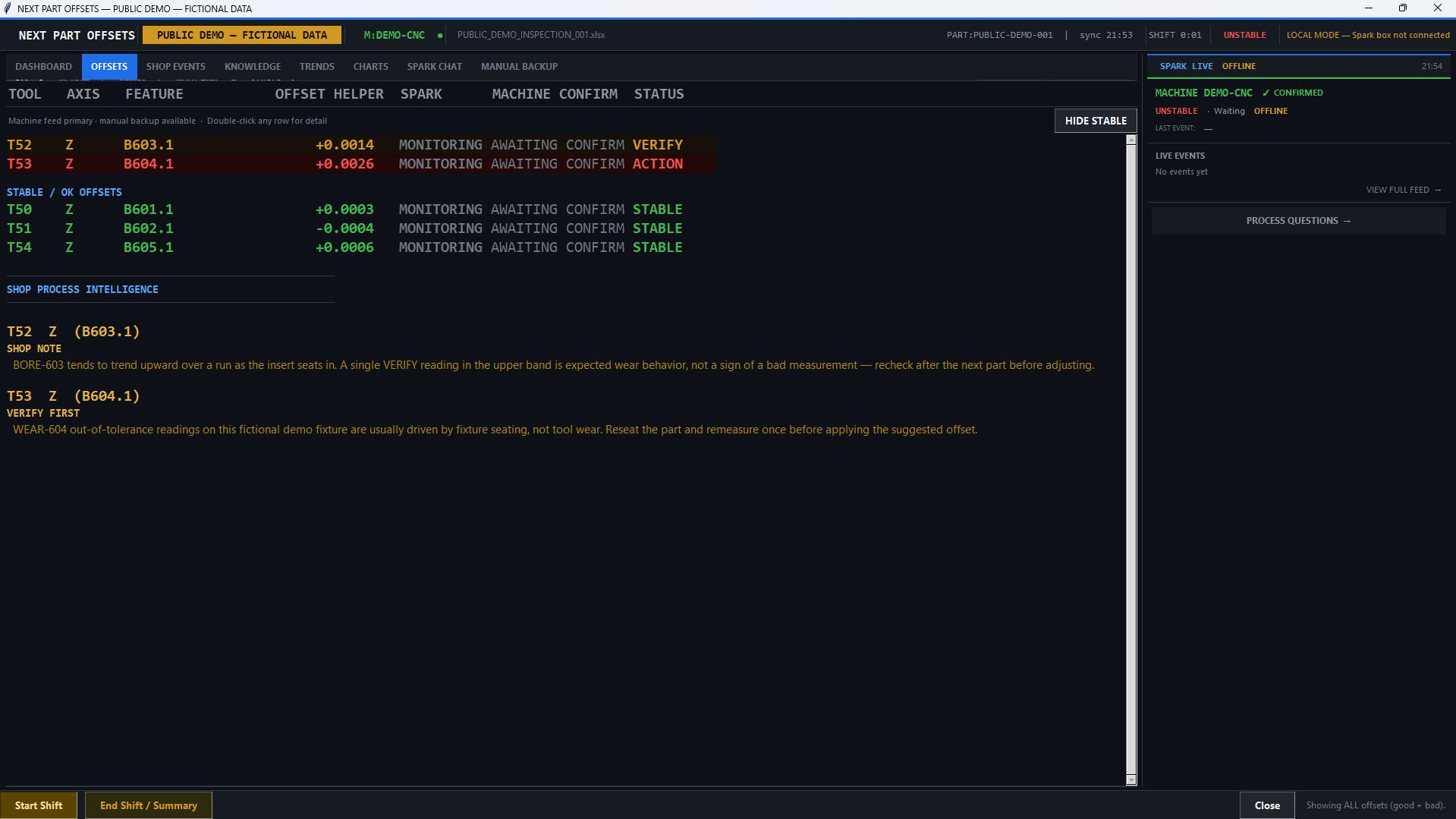
CMM / Inspection Results
Measured data from an in-process or final inspection.
Approved Process Logic
Deterministic, rules-based logic reviewed and approved for the process.
Operator Guidance
Clear, specific guidance presented to the operator.
Principles
- Deterministic, rules-based logic — not a model guessing at an answer
- Works from CMM/inspection results evaluated against approved process rules
- Built for process consistency across parts and shifts
Precision Offset Helper can operate independently or integrate with SPARK when broader process context and history are needed.
Precision Offset Helper does not autonomously control the CNC, and AI does not independently make machining decisions. Guidance is deterministic and rules-based; the operator reviews it and decides what to do.
S.P.A.R.K.
SPARK is a modular manufacturing-information platform that brings approved knowledge, process history, production context, and available evidence closer to the people who need it on the floor.
Shared NORMAL, WATCHING, or ATTENTION context based on available process evidence.
AI-assisted retrieval from approved manufacturing documents, process knowledge, and history, with source attribution.
A searchable record of supported manufacturing events such as measurements, offsets, tool changes, holds, and shifts.
Machine manuals, work instructions, and approved process or tribal knowledge brought into one controlled source.
Practical summaries based on the process information available to SPARK.
Serial-aware history where supporting information exists.
Part History depends on the information available to SPARK and may not represent every event for every serialized part.
Process Context, In Practice
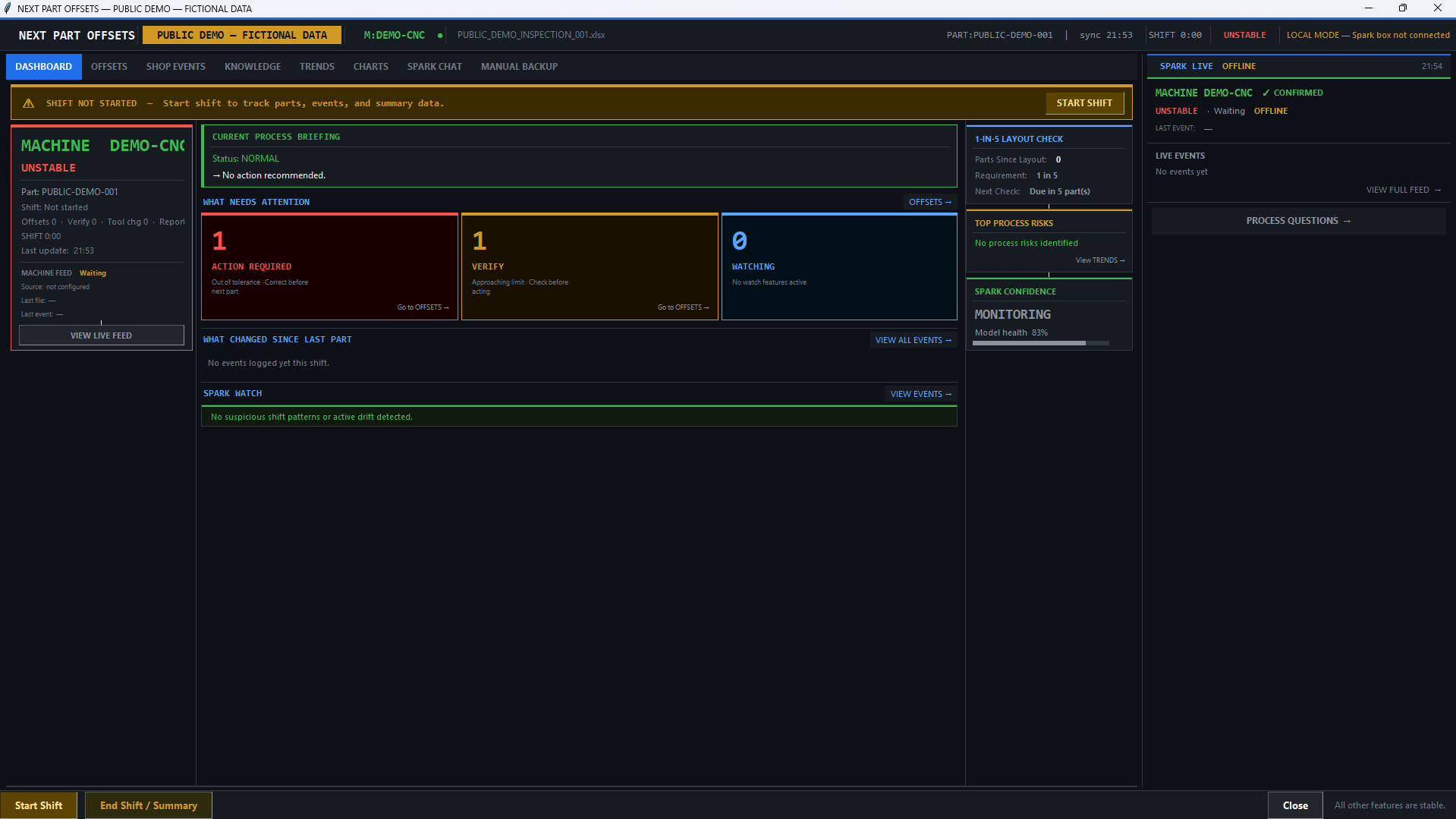
SPARK can retrieve, organize, and explain approved information. Deterministic process rules and human review remain responsible for machining decisions.
Built and Tested
Development discipline and real-world testing behind Precision Offset Helper™ and S.P.A.R.K.
Developed around real precision-manufacturing workflows
Deterministic, human-controlled machining guidance
Tested using real CMM inspection data
Machine-specific process rules and validation controls
Local-first handling of sensitive manufacturing information
Production telemetry research using read-only machine data
Clear separation between current capabilities and future development
Telemetry work remains read-only research. Testing with real CMM inspection data validates system behavior; it does not represent customer adoption or measured production savings.
Start with the process, not the product.
We begin with the real production process: how inspection, operators, machines, quality, and information currently interact. From there, we identify a specific problem and determine whether a focused software solution or process change is appropriate.
Spend time with the actual process, not a description of it.
Learn how inspection, operators, machines, and data currently interact.
Find the specific, repeatable problem worth solving.
Build a contained solution or pilot sized to the actual problem.
Check whether it actually helped, on the shop floor.
Refine it, or productize the pattern where it makes sense.
The goal is a contained solution sized to the actual problem, measured where the work happens, and expanded only when the results justify it.
Next: About ShopBuilt TechnologiesThis work started on the production floor, not in a search for somewhere to apply AI.
Precision Offset Helper and SPARK come out of hands-on CNC production experience — time spent seeing firsthand how inspection, tooling, operators, process knowledge, and production requirements actually interact on a shop floor.
The starting point has always been a real production problem, not a piece of technology looking for a use case. That’s the approach behind everything on this page.
ShopBuilt Manufacturing Technology Brief
A practical review of developments in manufacturing software, artificial intelligence, automation, machine connectivity, and production data—focused on what could actually matter on the shop floor.
Every brief is personally selected, reviewed, and verified against original sources by Brad Schlehuber before publication.
Read the Technology BriefNext: About the FounderAbout the Founder
I’m Brad Schlehuber, a working machinist and the founder of ShopBuilt Technologies.
I began building manufacturing software after repeatedly seeing valuable production knowledge scattered across inspection reports, spreadsheets, procedures, and conversations. Operators were expected to interpret that information and decide what to do next, often without a consistent system connecting it all.
Rather than waiting for someone else to solve those problems, I started building the tools myself.
That work led to Precision Offset Helper™, a deterministic system that translates inspection results and approved process rules into controlled next-part offset guidance, and S.P.A.R.K., a modular platform for manufacturing knowledge, process context, and production intelligence.
My work begins on the production floor—with real machines, inspections, operators, process variation, and practical constraints. The goal is straightforward: build manufacturing technology that is useful, understandable, and realistic enough to work where parts are actually made.
Show me the process.
If your production operation has a repetitive problem involving inspection, decisions, information, knowledge, or workflow — start with a conversation. No pitch, no assumption that software is the answer.